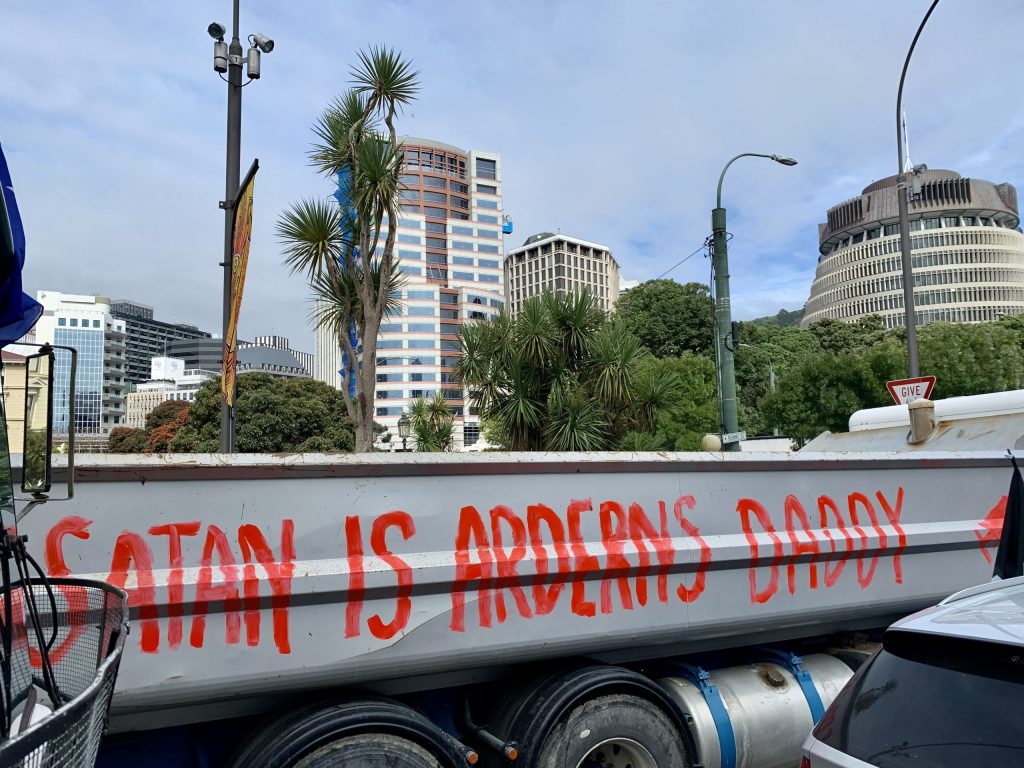
As I start writing, the tent encampment on parliament grounds that resulted from “Convoy 2022” remains in place. Rain is belting Wellington and the sprinklers have been turned on in a rather spiteful effort to encourage the protesters to disperse overnight. It might peel off a few, but after four days I suspect the loyal core of the movement are the bulk of the remaining demonstration (at the time of publishing the standoff has dragged on towards a week). Overseas the trucker occupation in the Canadian capital of Ottawa from which Wellington’s latest headache draws inspiration continues apace, nearing three weeks since the first procession left Prince Rupert on the 22nd January. Similar convoys are slowly working their way across Australia, France, the Netherlands, Cyprus, Austria and Belgium, among dozens of other planned convoys. While the faithful camped out on the parliament lawns may feel isolated from their fellow countrymen and embattled by a significant deployment of police, they don’t lack for international comrades-in-trucks.
Although their goals are amorphous (owing in part to the medley of alternative realities inspiring many of the demonstrators), it can be said that opposition to vaccine mandates and public health measures to curb the spread of Covid-19 hold together the motley coalition. Though I am at times uncomfortable with how the vaccine mandate has been rolled out, generally speaking I support a robust public health response including all the tools available to combat the spread of Covid-19 – mass vaccination and curbs on public association included. So in no way do I wish to be mistaken for a sympathiser with the demonstration. In saying this, neither am I baying for mass arrests nor a crackdown on the encampment by boot and baton. It is how the response by parliament and the police to the demonstration may play within the wider movement, and how this might reverberate going forward, that interests me here. And while only one person’s opinion, I hope in writing here I give the reader pause to consider the internal dynamics of this movement as a social movement, more than just a collection of the maladjusted.
The first step is, well, who are these people? What do they want and who makes up their movement? To look to the first of these two, I will be taking a relatively simplified approach. Much could be said of the ideological and social mix making up the movement, and how each informs the other. Many disparate communities are bringing with them differing ideological baggage into the wider movement, and as those communities mingle so too do their established ideas. So while one could spend a great deal of time delving into vaccine hesitancy, alternative medicine, right opposition to the state, sovereign citizenship, the new age, QAnon, etc, etc; I am instead focused on the widest possible platform these demonstrators are standing on. Which is to say, what is the broadest unifying position held by the widest possible assortment of people within the movement being assessed here? On that I believe, as stated above, that opposition to the vaccine mandate, public health measures, and as such to the government itself for putting them in place constitute the core position of the movement. This opposition acts, in part, as a stand-in for opposition to state interference into the social life of individuals; and social interference into the individual at all. Hence the sloganeering around bodily autonomy, choice, tyranny, and freedom; which seem entirely disinterested in the realities of a public health emergency or the interference it has on the lives of individuals. A viral disease is an inherently social phenomena after all, it does not distinguish nor care for the individual beyond its utility in further spread and contagion.
So, while a vast swamp of conspiracy and ideology animate many of the participants, it is a common opposition to state interference in the form of vaccine mandates and public health measures that tie together these disparate ideas into a single movement. Henceforth I will refer to the movement as the ‘anti-mandate’ movement, for simplicity’s sake, while remaining aware of the wider ideological soup the movement represents. To the second question, I again wish to try and tease out a few strands which might be used to paint a picture in broad strokes. It will be some time before real research into the social makeup of this movement gets done, if it ever winds up happening at all. Many vectors will fascinate the sociologists, pol-sci wonks, radical right monitors, and assorted curious for time to come. The cleavages along class, race, religion, and geography are assuredly rich and varied. For the purpose of this article, some clear groupings seem to have made their presence known above the rest.
The most recognisable are the new agers, alternative medicine practitioners, hippies, and ravers around whom the calls to rely on natural immunity and arguments around choice hold particular sway. This grouping might be majority Pākehā but likely include Māori and Pacific Islanders or at least include some who are adjacent to this community and swim in similar waters to them. The confluence of new agers and conspiratorial thinking is a story stretching back into the heady days of the ’60s and beyond, and doesn’t need to be relitigated here. They also include a good number of new age spiritualists, both in an ‘organic’ form and in syncretic formations fused with traditional Māori beliefs and various Christian denominations. Another religious factor are predominantly Pentecostal, typically fundamentalist Christian congregations, the most prominent of whom are Brian Tamaki’s Destiny Church and to a lesser extent Peter Mortlock’s City Vision Church. These are well distributed geographically and tend to either be majority Māori/Pacific Islander (i.e. Destiny) or majority Pākehā (i.e. City Impact). For them the response to Covid-19 is an article of faith in the Lord to protect His chosen few, and a highly useful wedge issue to drive recruitment and publicity on the side. This group is more explicitly aligned with right-wing politics, standing in a tradition of activism by the Christian right which has been periodically highly visible over the last few decades. At times natural allies of the Christian right is the closest thing to a ‘trucker’ faction of the demonstrators, made up of largely rural or semi-rural small business owners and independent contractors (probably joined by a smaller number of direct waged-workers in similar industries). They bring with them some of the concerns expressed by last year’s Groundswell protests, and are probably partially responsible for the anatopistic appearance of pro-Trump iconography at the demonstration as well as anti-communist sloganeering. They also made up a notable section of the convoy part of “Convoy 2022”, being geographically better disposed to join the convoy at regional stops as its two columns wound up and down the country.
These three sub-groupings, I believe, likely make up the most coherent groups of people who were able to bring actual numbers to either the convoy or the occupation in an organised fashion. Noticeably absent from this are the organised extreme right and the conspiracy media-sphere, both of whom are either supportive of or involved with the demonstrations. The former, embodied primarily by the young fascists of Action Zealandia, operate almost entirely underground and have very limited numbers making them both numerically insignificant and highly limited in their ability to influence the demonstration, ideologically or strategically. The latter, embodied primarily by New Zealand’s chief alt-media grifters Counterspin Media, have a great deal of ideological influence but are neither great in numbers nor able to directly intervene in the organisation of the occupation on the ground. They function as a megaphone on the sidelines, boosting the fringe-most ideas represented within the crowd but unable to do more than hope their growing audience acts on their calls to action. Both groups are significant for their presence, but don’t represent one of the definable social groups from which the demonstration draws steam, instead trying their best to influence those groups in various directions.
With these factors in mind, what will the actions of parliament and the police mean to the movement as it goes on? Eventually the occupation will end but the movement will remain, and what happens at this occupation is going to have a great significance for the movement going forward. It will be an historical touchstone, a lesson in strategy, a claim of street cred (“Yeah, I was at Convoy 2022, held out strong throughout”), and a point of rupture that permanently affects the direction of the movement once it’s over. Indeed much has been said of the tolerance shown by police and the government over the course of Convoy 2022 and the wider anti-mandate movement. It is unquestionably true that the iron fist has been sheathed in the velvet glove as the occupation nears a week in length, but it must be considered what options are available to the forces of order to mitigate potential unrest while avoiding fueling the deep-seated paranoia inherent to the movement. That factor will magnify any attempt to unsheathe the iron glove in dealing with the occupation, providing vital resources for the creation of a narrative of a valiant fight against tyrannical repression. This is something the authorities will be keenly aware of. There are two effects that they will be making serious efforts to avoid: one, the heightening of protest militancy at the occupation (and after) at a wider movement level; two, that the temperature is sufficiently raised that terroristic militancy is spawned at a smaller individual level.
Yet the authorities are pressed to do something, the politicians are being shown up by court jesters on home turf while police are watching a tally of minor crimes and infringements steadily grow from mole-hill to mountain beneath their noses. It would be no surprise if some in relevant positions support a return to mass arrests in an attempt to fatally weaken the resolve of the remaining demonstrators resulting in the end of the standoff as those avoiding arrest finally head home. Others will be hoping that the poor weather, continuous police presence, public animosity, and worsening conditions in the camp will essentially do the job for them without the need for busting the encampment up and risking generating public sympathy for the movement. I personally suspect many in parliament sit somewhere in between and the police are primarily interested in a clear strategy one way or the other so the matter can be closed, resources drawn down, and the focus can shift to the prosecution of various crimes and infringements incurred by the protest.
So, their question is whether busting up the tent encampment is the best course of action while considering those factors. Even with the better option, that the encampment ends without actions that heighten the temperature of the movement overall, its aftermath could still have positives for the movement. If the movement has keen-eyed strategists able to claw some degree of influence, the aftermath of the occupation will leave them with certain options to keep the movement engaged and active. Now is their time, if they exist. Leaving aside the potential to spin the encampment into legend and strategic experience gained, there will be the matter of possibly hundreds of fines and minor prosecutions to sift through the courts. This could be its own cause célèbre, a site of organisation in the form of campaigning to get charges or fines thrown out (of which I suspect many will be either let off with a warning or have charges dropped regardless), a point of fundraising for the same purpose, or at the least a court spectacle as a freakshow of sovereign citizen-influenced ideas play out before Wellington judges. Busting up the encampment may well be worse, spawning folk heroes or future militants for the movement and raising the temperature for some of those who already see this as a life-or-death struggle.
This isn’t meant to be a policy prescription or a clear statement of what I think should be done. I’m generally happy for the encampment to slowly fade away as funds dry up and the weather wears the faithful thin, although it would be good to tow their vehicles and step in when they harass passers by so the National Library can reopen again. I believe any direction the authorities take will open up avenues of opportunity for the movement, and the question for them is merely what the least bad option is to save face as Wellingtonians wear increasingly thin in their resolve to deal with the encampment. But what direction is eventually taken will be important, and what the demonstrators choose to do in its aftermath will impact the future course of the anti-mandate movement overall. Different social groups will react to how the encampment ends differently, and they will bring those considerations with them into future actions. That is a factor those interested or concerned with the movement will need to consider, as the movement itself grapples with them going into the future.
I’d like to end with a few articles and assorted pieces on the protest I think are worth a look. I feel it’s wise to read widely if one wants to try attain an understanding of the encampment and what is at work within the movement keeping it going. So here are a few things worth your time.
Inside the disorienting, contradictory swirl of the convoy, as seen through its media mouthpiece
Charlie Mitchell, stuff.co, February 12 2022
NZ has a trucker convoy, because protests are global now
Dylan Reeve, The Spinoff, February 9 2022
‘Splintered realities’: How NZ convoy lost its way
Marc Daalder, newsroom, February 12 2022
The people behind the capital protest: many adamant days on
Ellen O’Dwyer and Matthew Tso, stuff.co, February 12 2022
Signs of a schism as anti-mandate protesters turn on each other
Toby Manhire, The Spinoff, February 9 2022
In-fighting between Freedom and Rights Coalition, Counterspin continues at convoy protest after event ‘hijacked’
Rachel Sadler, Newshub, February 9 2022
The Anti-Mandate Occupation: A Reactionary Convergence
Editorial, Socialist Review, February 14 2022
Photos of the Parliamentary Grounds occupation-protest
Bryce Edwards, Democracy Project, February 12 2022
Photos of Anti-vaccination protests at Parliament
Bryce Edwards, Democracy Project, February 9 2022
Convoy protest doomed to fail – Minto
RNZ, February 10 2022
Covid-19: Differing opinions on how to handle protest
RNZ, February 14 2022
One final note, while not related to New Zealand I very highly recommend this Greek intervention on capitalist priorities during the pandemic, state failures in healthcare, and covid denialism on the right and left in Europe. It is one of the single best pieces I have read throughout the entire pandemic and I figure here is a good place to promote it.
The Reality of Denial and the Denial of Reality
Translated by Cured Quail Journal, 9 December 2021
Originally published by Antithesi / cognord, 23 September 2021

 Notes South from Nowhere
Leave a comment