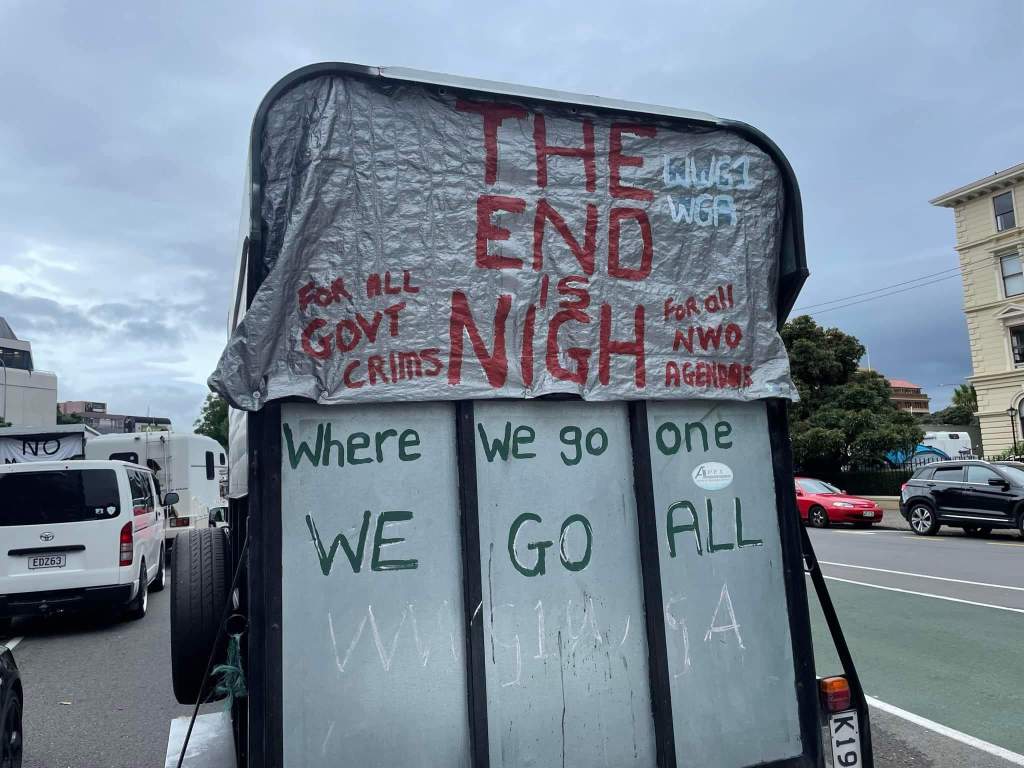
After something of a break from writing over the length of the pandemic, it is probably somewhat unusual for me to write here so soon after I last published something. Alas, the story that has gripped media headlines and the attention of the country for close to a fortnight looks to be more entrenched by the day, and in such fluid conditions my previous piece requires further elucidation and thought as the situation develops. By and large, I’d like to expand on some of the points from that article (here if you’d like to read) and further attempt to draw out threads which might make sense of the social movement that underpins it. And it is a social movement, it is by those dynamics best understood. Social movements can be of near any political substance, progressive, reactionary, or mixed, it is the function and makeup of said movements that is in question. And I think the makeup of this movement is one that will be argued for some time, as indeed it is now.
It can be said that, in a strict sense, opposition to public health measures represented foremost by the vaccine mandate remains the rallying point for the movement. This is true insofar as a face removed from a head and stretched crudely upon a basketball remains a face, it barely covers the mass contained beneath and convinces few that it is simply a face and nothing else is in question, but a face it still is. The anti-mandate cause holds together a vast array of beliefs, as has always been the case, but it is less and less able to restrain them in order to present a united front. So the anti-mandate movement remains just that, but it is stretched terribly thin and only continues to be the unifying cause because it is the primary demand every faction believes in.
What ‘anti-mandate’ means has slowly been changing before our eyes as well. It is an end to mandates and public health measures as well as retributive actions for enacting them in the first place. I wrote previously that because the movement was against the measures taken to curb the pandemic, it is as such a movement against the government for enacting them in the first place (and the opposition for supporting the measures). This can be expanded. It is a movement first to have the measures ended and second to enact retribution for their being brought into being in the first place. Earlier in the course of the occupation, when more “moderate” (a word that seems to have been used interchangeably with “organised” or “rational”) elements held a greater degree of sway, the former could be said to be the dominant demand. This is no longer the case. While the anti-mandate cause remains the grand unifier, it has been loaded with additional meaning that allows for more fringe demands to be made within the call to end public health provisions. I make this point so that it is clear that while I continue to use ‘anti-mandate’ to describe the movement, the meaning of ‘anti-mandate’ has been loaded while retaining its original core.
When I originally looked at the occupation, I identified three social groups I believe provide some of the base for the movement. The first are the ‘alternative lifestylers’ associated with alternative medicine, hippie culture, wellness culture, ‘spiritualists’, and new age mystics. This group includes syncretic faiths fusing new age ideas with traditional Māori beliefs and Christian denominations. Second are religious zealots, typically fundamentalist Christians and often from Pentecostal congregations, of which Brian Tamaki’s Destiny Church is the most recognisable along with Peter Mortlock’s City Impact Church. While Tamaki hasn’t shown up at the protest (owing to his legal troubles for previous protests) the Destiny front group Freedom and Rights Coalition has been an on-again/off-again presence and as I write another convoy is making its way from Auckland to Wellington under their banner. Peter Mortlock, on the other hand, has been posting videos to Facebook from the encampment. Third are rural and regional small business owners and independent contractors, who most closely resemble a ‘trucker’ faction of the protest. These people were likely crucial to the convoy part of Convoy 2022 as their numbers allowed for reinforcements for the two columns of vehicles at rural stops throughout the country and could be counted on for roadside pickets to meet the convoy as it passed through.
A social group that seems obvious but I didn’t mention in the previous article are those made newly unemployed by the mandate. I think it should be clearly stated that these are not necessarily working-class as a whole but I would suspect a mixed bag of some workers, professionals, independent contractors and small business owners. A set of class fractions EO Wright might identify as existing near the intersection point of skilled, semi-independent workers and the lower echelons of the petite-bourgeois. In part I didn’t mention this group is because it is likely spread between the other three much as those other three cross over with each other. There is no one direct representative for this group, but it can be said that the anti-vaccination NZ Doctors Speaking Out With Science (NZDSOS) act as such for the health sector. There is, again, crossover here as the alternative lifestylers likely see NZDSOS as a legitimising actor for their own fears around modern medicine, providing the organisation with a ready and willing audience in return. Another group, again with crossover into the others, is a faction of radical mostly Māori who bring with them a mixture of decolonial and sovereign citizen ideas that views the state above all else with hostility. While the Sovereign Hikoi group are the most readily identifiable organisation, this social grouping is broader than any one organisation and carries with it a long standing cocktail of homegrown conspiracies and foreign imports. The mixture of Māori sovereignty politics with sovereign citizen conspiracies is not new, and allows for this group to meld with other conspiratorial narratives with ease. It is in the field of conspiracy, with its anti-semitic and anti-communist underpinnings, that allows for Māori and Pacific Islanders to work alongside the neo-fascist fringe. Anti-semitism (and perhaps in other circumstances Sinophobia and Islamophobia), operating in a mostly coded though sometimes open form, provide Pākehā and Māori with a common outside enemy bent (in their narrative) on turning back the progress made by the two peoples toward national unity. This framework allows for claims of Māori sovereignty to be made in a kind of compact with Pākehā born of blood shed in common, treating the state and a shifting mélange of foreign actors as a threat to Māori and Pākehā alike.
Each social group brings its own priorities and conspiratorial ideas into the mix, which is being supercharged by the constant in-person presence of these groups among one another. The rapid spread of these ideas, noted with alarm by those who keep an eye on this world, can be in part explained by this effect. Ideas can travel rapidly in a crowd, especially one as agitated as this. Furthermore as ideas are transmitted both digitally and physically, bouncing back and forth from one to another, they form a continuous cycle. People are spreading ideas digitally over and over again, spurring those on the ground to transmit those ideas by interpersonal interactions and speeches, which are caught on livestreams to reenter the digital continuum. A near perfect environment presently exists for this cycle, and the circuits are tightening.
So in considering this, what options will have what effect in dealing with this? In many ways the question is already moot. Numerous avenues of action have slipped from the table as the days slipped by, and I fear few directions lead to a peaceable resolution now. First is the status quo. It seems clear that left to their devices the encampment will grow to cover a significant section of Thorndon and Wellington Central, surrounding the parliament and reaching everything from MBIE, the District Court, and the Indian High Commission in the south; the Ministries of Education and Primary Industries, and the British High Commission in the west; the streets adjacent to the port district in Pipitea to the east; the Thai and Argentine Embassies to the north; and from there beyond. Make no mistake, where the Ottawa occupation developed into an economic crisis as key trade routes were blockaded, in a matter of days (if not already) the encampment will turn into a political crisis disrupting the normal operation of numerous arms of the state. While this is far from some decisive blow that will lead to a coup d’état, it’s a windfall for the not insignificant reactionary elements who will be thriving in such circumstances. Further, the unstopped growth of the encampment will facilitate the rapid spread and speed of the aforementioned cycles of conspiracy. This is, I believe, creating a pressure cooker effect in which the kind of temperature raising a crackdown may have caused will generate itself as paranoia swells with the crowd itself. Though a violent outburst is not inevitable in this circumstance, it is not unthinkable either. This is the application of neither the ‘velvet glove’ nor the ‘iron fist’ but a near nonapplication, an absence of strategy entirely. Even if the occupation ends tomorrow, it will have scored an immense victory for the movement in rendering the police incapacitated and paralysing several blocks of the city for a fortnight without the use of mass violence. It cannot be stated how much experience for future action is being gained by a movement that is now well embedded across the country, even if its social base is relatively small.
To the ‘iron fist’ option, this seems unlikely as the Police Commissioner Andrew Coster appears well aware of the volatility of the situation, something that at least partially explains the paralysis of the police despite an early move to stage mass arrests in the first week. The full implementation of this option looks perhaps something like this: the army engineers are mobilised to begin towing vehicles, damaging most in the process; additional police resources are called from around the country and riot gear is issued to numerous units of police; cordons are established at key points on parliament grounds, Molesworth Street in the north and Lambton Quay in the south, and some other streets with gaps to allow groups to flee as a means of sapping the occupation of numbers and dissipating its concentration; baton charges are made at outlying streets while a mass of police is maintained at parliament to stop reinforcements arriving at the outlying points of the camp; mass arrests occur and in the worst circumstance serious fighting breaks out on several streets with large numbers caught in the middle; the camp is slowly cleared over one or several days. This would raise the temperature immensely and see an environment of mass radicalisation among the faithful. As outlined in the previous article it could produce the circumstances in which future terroristic militants are made, and spawn any number of movement martyrs and folk heroes who would be a boon to the movement going forward. At best it could fatally weaken the resolve of the movement, but only in the short to medium term, regrouping would be inevitable and driven by new resentments.
The ‘velvet glove’ is not really an option so much as however many tactics and strategies are still viable between the ‘iron glove’ and nothing. It is neither appeasement nor brute force, an attempt to chart a course that sees enforcement carried out without the pressure cooker going off. Some form of this direction has likely been the best course of action from the eyes of the state since the camp weathered the storm that battered Wellington early in the occupation. It involves anything from hardball talks to tie down movement ‘leaders’ (more so to keep those who’re decent strategists and organisers away from the camp) through continuous towing of vehicles to stopping erstwhile occupiers from arriving with vehicles to kettling sections of the camp at the outskirts in a piecemeal fashion whilst maintaining a high enough police presence at parliament to hamper efforts at reinforcement. There are any number of ways minor infractions could be policed so as to thin the outlying crowds, demoralise the occupation, or box in the encampment. It is not my place to give the police advice, nor my interest, but I want to make clear that the forces of order have always had a mixture of these options at hand and have for reasons of strategy or paralysis avoided them.
The ‘velvet glove’ throws up a new contestant to the field as well, working and middle class Wellingtonians acting in a self-organised manner to show opposition to the occupation in contravention of the wishes of the police, governing, and opposition parties. As yet there are only stirrings of this actor in the play. How this faction-in-waiting acts is the wildcard option. I’m not sure what effect they will have on the internal chatter and future dynamics of the movements, but it won’t be the same as how the response of the authorities will be received. Being faced not by uniforms but regular clothing is a much different state of play, one that will give the wavering an uncomfortable situation to deal with. It could swing either way, spurring on radicalisation or cleaving off a segment. Or, for that matter, both. What actions are taken, too, will have differing effects. A poster campaign, a mass rally, a determined clash, each will act in different ways to influence the movement in different directions. The first may be moderately positive, or taken for some kind of deep state media blitz. The second may demonstrate a collective outrage at the occupiers excesses and a sense of popular opposition, or give the radical right the grounds to divide the wavering from their loved ones even further. The third may strike a fatal blow against the resolve of the occupiers and prove a coup de grâce in ending the stalemate, or the occupiers might win and leave the field stronger than ever. It’s a step into the unknown to consider how it might play out, as is the case when social movements collide in such a way. The only way to know is to try. This is not to give advice or state ‘how I would run things’, but to give those who might read pause to consider their options before moving forward. There exists a fertile environment at the encampment that can be radically altered in its composition, direction, and strength by prevailing events. Do with that what you will.
This piece was originally meant to be a supplemental to the earlier piece, but much like events it has gotten away with itself. I can’t do much else from the deep south but write. However, as I haven’t written for much of the pandemic, I hope what I have metaphorically put to paper here is of use to someone in trying to conceptualise the dynamics of this occupation and from there taking what actions they deem appropriate. At any rate I leave this here with the promise I will likely be returning to the topic, perhaps sooner rather than later.

 Notes South from Nowhere
Leave a comment