
More material from the Broadsheet archive that’s caught my eye as I continue my deep dive into that wonderful resource, this time a collection of four reports on arson attacks against abortion clinics and services in New Zealand. Anti-abortion violence and activism is one of those ‘very well known, to those in the know’ topics in New Zealand, entirely unsurprising to those paying attention but something that might catch the unawares by surprise. The specific matter of using arson as a weapon of political violence is depressingly familiar to those with even a cursory knowledge of the long and bitter fight for access to abortion over the last half century or so. Those who retain a relatively rosy outlook on the role of political violence in New Zealand history may be surprised to learn how often the tactic of arson has been used here, especially as recently as the post-war era of the mid-20th century onwards. Republishing these reports here is in part about keeping this unfortunate chapter of women’s history alive, in part a warning of the ‘it can happen here’ kind, and in part about dispelling the illusion of a stability and peace only occasionally interrupted by violence and unrest since the end of the Land Wars. The reports date to 1976, 1978, 1985, and 1987; and they don’t encompass all of the acts of arson conducted during the period of Broadsheet’s publication, but the substantive reports which Broadsheet undertook on the matter. These four reports offer a contemporary insight into the violent opposition these women faced in a place once known as Godzone…
Arson at Abortion Clinic (Broadsheet #39, May 1976)
How far are anti-abortionists prepared to go in thrusting their views on the rest of the population? SANDRA CONEY reports on the fire at the Auckland Medical Aid Centre.
In its almost two years of operation the Auckland Medical Aid Centre has had to overcome several challenges to its continued existence.
There was the seizure of several hundred of the clinic’s patient files followed by the two trials of Dr James Woolnough. Although Dr Woolnough was acquitted at the second trial, that crisis is not yet past as the Court of Appeal is at present reserving its decision on an appeal by the Crown against that judgement. In 1974 Dr Wall introduced legislation into Parliament which culminated in the Hospitals Amendment Act which was eventually passed in 1975. Fortunately the clinic was able to continue operating by purchasing the former Aotea Hospital in the Auckland suburb of Epsom. That battle too is not finally resolved; there have been rumours that the Minister of Health, Mr Gill, is dedicated to closing the clinic, or what he calls, properly implementing the intended spirit of the Hospitals Amendment Act.
Anti-abortionists have found the continued ability of the hospital to stay open galling and they staged a three month long daily vigil outside Aotea Hospital last year. Organised anti-abortion groups like SPUC and Right to Life disclaimed any responsibility for the protesters outside the hospital but at times hospital staff recognised known anti-abortionists from both organisations amongst the protesters outside the hospital gates.
In November Mr Gee, a right-to-life candidate in the Remuera electorate, set up camp outside Aotea Hospital, with all the trappings of an American electioneering rally. Supporters sported T-shirts emblazoned with foetuses, music blared over microphones and huge posters decorated the gathering as it daily met on the pavement outside the hospital. This group mysteriously disappeared the day Dr Woolnough was acquitted in his second trial.
Besides these obvious signs of organised and rabid opposition to the centre there were other signs that some fanatics would never accept the presence of a centre performing abortions. Hate mail regularly arrived; not reasonably argued letters but newspaper cuttings scrawled with “Murderer” in red ink and the like. The former medical director, Dr Rex Hunton, was harassed with threatening telephone calls at his home. Early this year there were bomb threats against the hospital. These were not made public for fear of alarming patients coming to the hospital.
When I wrote about the activities of anti-abortionists outside the hospital under the heading “Right-to-life hysteria outside Aotea Hospital” late last year I concluded: “It is quite conceivable to me that these people would resort to arson or assault, so reckless is their disregard for human life – when it’s adult and female”.
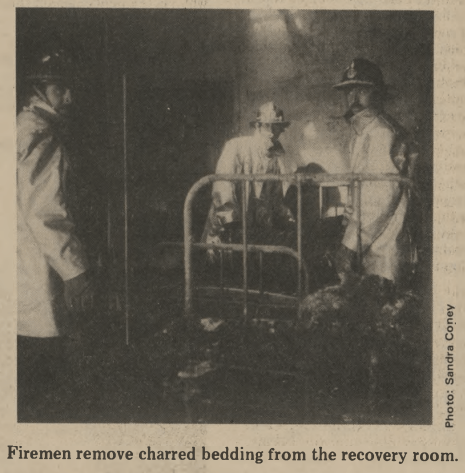
It seemed a very real danger at the time but it nevertheless came as a terrible shock to hear on the morning of April 1 the news that the hospital had been badly damaged by fire.
Rosemary and I went over to see the hospital about eight hours after the blaze had started and were shocked. Firemen remove charred bedding from the recovery room. and dismayed at the damage. Firemen were still carrying out charred bedding and furniture and the hospital staff, some of whom had been up since three that morning, was trying to make some order of the chaos.
The Auckland Medical Aid Trust Hospital is a large kauri building, about forty years old, set amongst sweeping lawns with trees and flower beds.
The damage was not really noticeable from the street apart from the fire engines outside and a tarpaulin covering a hole in the slate roof. Although at the moment arson has not been proved, we can reasonably
assume that it was. The person, or persons, who started the fire either entered the hospital through a french door onto a veranda at the back of the hospital or started the fire on the veranda. The veranda is surrounded on three sides by the building and all the rooms bordering the veranda were extremely badly damaged. Woodwork inside and out was completely charred, there were holes in the floor and through the ceiling and roof. Water was everywhere, turning the floor into blackened slush and in other parts of the hospital causing sooty trickles down the walls. The smell of smoke was overpowering; the horrible smell of burning has still not left the hospital two weeks later.
About a third of the hospital has at present been boarded off because it needs rebuilding as a result of the extensive damage. All floor covering and paintwork inside have to be replaced. This is particularly
distressing for those running the hospital as recently they had purchased new curtains and bedspreads and the hospital was in the process of being repainted and generally smartened up.
Anna Watson, a member of the Auckland Medical Aid Trust was not, however, too depressed about the present situation.
“Of all the disasters the centre has been though, this has been the easiest to deal with. Although, it was the most soul destroying because it looked so terrible, at least we had some control over it. With our other crises, like the Wall Bill and the police raid, we felt so powerless. Our fate was in the hands of other people.”
The staff at the hospital is as usual rising to the occasion, and with a lot of support from friends, managing to keep going. At least a hundred people turned up to help clean up the mess the weekend following the fire. All counselling has had to be transferred to the nurses’ home at the back of the hospital and the numbers of women being seen has had to be cut down. Fortunately, the theatre was not damaged at all in the blaze, neither were any files destroyed.
The damage has been roughly estimated estimated as being in the vicinity of $100,000, but the hospital was fully insured. The police are investigating the fire; ironically the detective sent to lead the police enquiries was Detective Sergeant Lambert, the man who led the police raid on the clinic to seize the files.
The administering body of the hospital, the Auckland Medical Aid Trust, is now planning ways of trying to ensure that this can’t happen again, a difficult task given the twisted motivation of a person who would commit such a destructive and life threatening act.
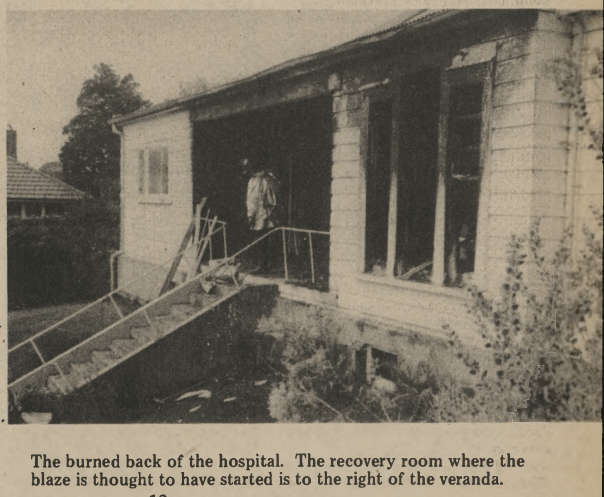
Every time there is a crisis at the Auckland Medical Aid Trust the person person who suffers most is the woman trapped with an unwanted pregnancy. It is she who is tortured with worry and fear.
Writing in Thursday magazine, Sue McCauley once described noted antiabortionist Dr Pat Dunn, as having tunnel vision. I think all antiabortionists must share this quality with him. In their determination to impose their rabid views on others they are blind to the suffering of the thousands of adult women who are made prisoners of their own bodies. They are only capable of seeing things in the starkest shades of black and white; a comfortable way of simplifying moral dilemmas.
Some anti-abortionists, of course, will try and disassociate themselves from the activities of those who would resort to arson or worse for their beliefs. But they must share some of the blame as law-abiding anti-Semites must for Hitler’s actions. Arson is only the logical outcome of such an anti-life stand as is embodied in an anti-abortion philosophy.
Arson at SOS (Broadsheet #59, May 1978)
Wanted — New rooms for SOS, brick and in a well-lit location.
The Sisters Overseas Service (SOS), an organisation which helps women to get abortions in Australia, was burned down at Easter. SANDRA CONEY reports.
Easter is a time when arsonists’ matchbox fingers start twitching. At least that’s what you might
conclude from the Easter Monday attack on SOS headquarters in New Street, Auckland. The
women workers at SOS suspected something like this might happen. The AMAC hospital in Epsom
was attacked on April 1 two years ago — there seems to be something about the Easter festival that works anti-abortion fanatics into a fit of vengeful fervour and sends them looking for the petrol and the matches. The SOS women had rung the police before Easter suggesting a special eye to be kept on the premises because, besides forebodings about the time of the year, there had been several strange events in the weeks leading up to the attack: a telephoned bomb threat, four men in a car parked outside the offices all one day, a dazed looking man walking around in the street outside with a pair of surgical forceps in his hand. All these events worried the SOS women and so fortunately all important files and documents were removed from the offices before Easter.
The fire was lit about 3.30 a.m. on the morning of Monday 27 March and because the seat of the fire was in the side of the building facing the empty CSMC offices the blaze was not noticed by occupants of the motel on the lower side till 4.30 a.m. by which time it was well under way. By morning the building was a charred and soggy shell. Three attempts had been made to light a fire; once on the floor of an office, another in a hall cupboard and the final one, which took off, in the upstairs hostel accommodation. This burned fiercely, dropping through into the waiting room, kitchen and offices downstairs.
On Tuesday morning an SOS worker removing undamaged items from the kitchen found several large plastic containers which had held an accelerant on the stove. The stove had been turned on to high underneath them – the arsonist expecting that they would be destroyed in the ensuing blaze. But the old-model stove had fused, leaving the arsonist’s equipment intact. The police are trying to trace where these containers were bought and have been able to fingerprint them.
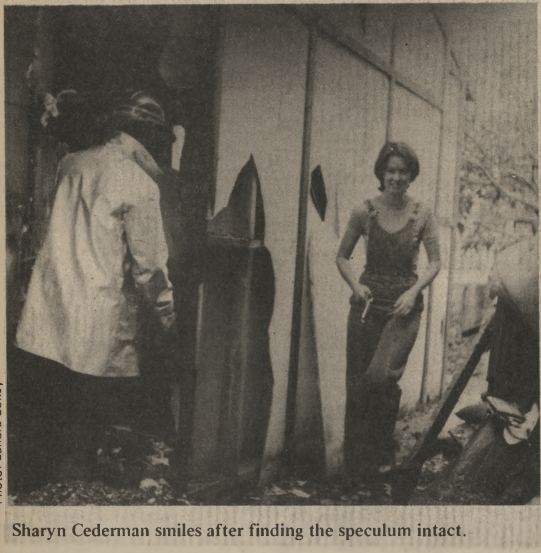
Who did it — cranks or organised
Of course people are asking each other who could have done this and most of the answers are that of course it must be some extreme anti-abortion crank and that the organised anti-abortion opposition would not be responsible for such an act. But it is quite likely that the firing of SOS is not just the isolated act of a fringe element in the anti-abortion ranks but further evidence that arson is being used internationally as a strategy against institutions performing abortions or helping women to get them. Besides the New Zealand experience of the firing of AMAC and SOS, clinics all over the world have been burned down or damaged by fire. The Preterm clinic in Sydney was severely damaged by fire a couple of
years ago and in the States there have been a number of similar occurrences, particularly at Preterm clinics. It may be stretching coincidence just too far to believe that anti-abortion “cranks” in such diverse places as Auckland, Sydney and Boston all independently arrived at the idea of committing arson on their local abortion service.
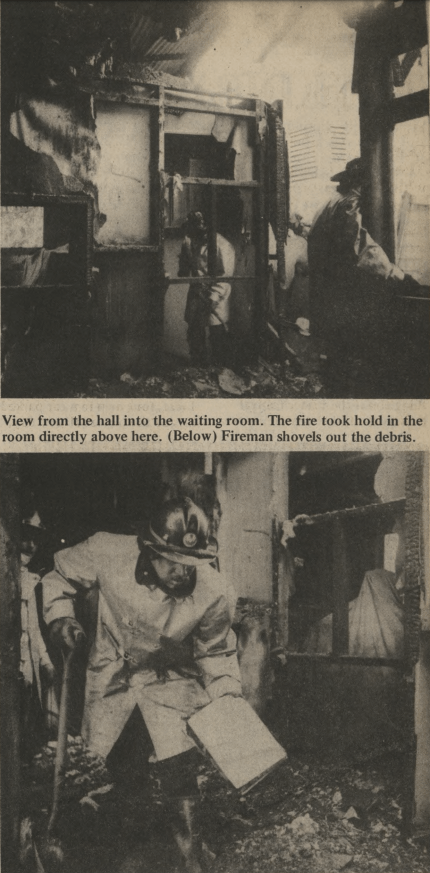
A tactic in the battle
Arson has long been used as a political tactic; even our suffragette sisters in Britain burned down buildings to show their anger and impatience after reformist tactics appeared to be getting them nowhere. Arson, when directed at a functioning service, is a crippling form of attack. As a weapon for anti-abortionists it is particularly useful. For, all the while that they are using conventional tactics (lobbying, meetings, publishing) to try to get restrictive abortion laws, they can see that abortions are still being performed (or babies murdered as they see it).
Arson is the easiest, most effective, way of preventing this happening. So while organised anti-abortionists may disassociate themselves from the firing of SOS it is quite conceivable that the act is not a random one. After the AMAC 1976 arson two Hare Krishna men blew themselves up while making explosives in their Grey Lynn backyard. There were suspicions that the bomb had been intended for AMAC (they had spoken to associates of “getting the meat works” and were violently anti-abortion) and therefore they were implicated in the earlier arson. Many people latched onto that explanation as it was more comfortable (Hare Krishna freak/irrational act/won’t happen again) than acknowledging that arson is a tactic in this battle. This latest act indicates that the same people might be responsible for both acts of arson since the tactic, the timing and the method in both fires is remarkably similar.
Besides being disruptive and destructive arson is also intimidating. Victims of an attack wonder when it will happen again and start to fear for their personal safety and for the safety of the place where they live and those who live with them. Only strong political convictions enable people attacked in this way to carry on.
SOS is now looking for new premises, preferably brick and in a well-lit place. They are not letting the attack get them down and are enthusiastically going ahead with plans to expand into a feminist health clinic with self-help groups and educational programmes.
Abortion Clinics Burn (Broadsheet #127, March 1985)
SANDRA CONEY discusses anti-abortion tactics, comparing the US with NZ.
“Opponents of abortion in the United States,” reported the New Zealand Times “have launched a nasty, and often violent campaign to deter women from having abortions.”
The nasty and violent tactics of the anti-abortion squad, are not limited to the US. New Zealand clinics are targets for the same kind of tactics. In our January/February issue we reported on the firing of the Auckland Medical Aid Trust hospital in Epsom on November 17, the night of the Auckland women’s forum. One wing of the hospital, including the operating theatre was badly damaged by fires lit in two places.
A second arson attempt was made on the hospital over Christmas. Fires were lit in the same places as the November attack. Fortunately they did not catch and the damage was limited.
In our previous report, we recalled similar attacks on New Zealand abortion facilities, noting that these had happened on dates of some significance, especially religious festivals. The same pattern is seen in the US. In Pensacola, Florida, three abortion clinics suffered pre-dawn blasts within a 22-minute span on Christmas day.
Twenty-nine abortion clinics across the US have been bombed or burned in the last three years, so far without loss of life, but abortion clinic workers say it is only a matter of time. In Granite City, Illinois, the director of the Hope Clinic and his wife were kidnapped, held for eight days and told they would be killed if they didn’t renounce abortion. Their kidnappers called themselves the Army of God and Don Anderson is serving a 30- year prison sentence for this and other crimes against abortion clinics.

But most bombing and firings go unresolved. The Federal Bureau of Alcohol, Tobacco and Firearms has offered large rewards for information leading to the solving of these attacks.
The US anti-abortion movement has gained in militancy during Reagan’s reign. It hoped that an anti choice president would help usher in laws which would outlaw abortion. They expected to win a
“Human Life Amendment” to the constitution giving the foetus the rights of a person. But various attempts to pass anti-abortion amendments and statutes have been defeated, and recent polls show that 75% of Americans support legalised abortion. So anti-abortionists are turning to new and desperate tactics.
Joseph Scheidler, a former Benedictine monk and director of Chicago’s Pro-Life Action League, has written a book called Ninety-Nine Ways to Close Abortion Clinics which he calls “death camps”. These include “truth squads” which infiltrate clinic waiting rooms pretending to be patients and talk loudly about their doubts about abortion hoping to precipitate a walkout. Scheidler used to picket carrying a pickled foetus.
Other tactics of the “prolife” camp have included the machine-gunning of a Florida clinic and the burning of the Feminist Women’s Health Centre in Everett, Washington. Before the fires this clinic was receiving 700 harassing phone calls a day.
Anti-abortion activists confront women patients with paint-splattered dolls, throw “holy” water at them and offer sidewalk “counselling”. Abortion staffers get their car tyres slashed, threatening phone calls and crosses carved on the front lawn.
New Zealand has not been free of these tactics. Besides the burnings, anti-abortionists have picketted clinics with rows of tiny white coffins, huge crosses, dolls, megaphones and rosary chanting. For much of
last year the Epsom Day Hospital was picketted by right-to-lifers with placards comparing the clinic to the holocaust (ironically Hitler was antiabortion for Aryans). “Counselling” was offered from a parked caravan.
New Zealand anti-abortionists don’t have much to learn from their kind in the US. It’s already happening here. And it’s obvious that here, as in the US, the troops are church based, although right-to-lifers are keen to downplay that connection. The frightening popularity of the fundamentalist churches with their groupthink mentality and emphasis on militant evangelism adds a new and worrying dimension to the abortion scene.
More Anti-Abortion Arson (Broadsheet #150, June-July 1987)
Jenny Rankine reports on attempts to stop women getting legal abortions.
Anti-abortion terrorists closed Auckland’s Epsom Day Hospital for six weeks with five carefully lit fires in April.
The official silence about the increasing severity of arson attacks and harassment of patients and clinic staff was deafening. The fire barely made the news in Wellington, and there was no government statement condemning the attack.
The Women’s National Abortion Action Campaign (WONAAC) sees the arson as the latest in a consistent series aimed at a legal and government-funded service and asked what the Security Intelligence Service is doing to investigate direct action antiabortion groups. The Society for the Protection of the Unborn Child’s leaflets and newsletters, for instance are inflammatory; they talk about abortion as genocide and war on the unborn, and the implication is that the anti-abortion fight is also a war.
Anti-abortion terrorist attacks in the United States have escalated and clinics are now being bombed during the day. It is only a matter of time before those in the US whose rhetoric is full of concern for
life kill someone.
The private Auckland Medical Aid Clinic, which has been at times the only operating abortion clinic in the country, has been set fire to three times. Last year, mainly for this reason, it moved from its rambling wooden building to a concrete block clinic.
The worst anti-abortion fire attack, on Easter Monday in 1978, gutted the Ponsonby house of Sisters Overseas Service. SOS was a national feminist network which arranged trips to Sydney for New Zealand women seeking abortions at a time when no clinics were operating.
While the Epsom operating theatre is out of operation, women will be counselled there and have their terminations at National Womens Hospital. Nursing union officials are concerned for their members at the clinic, angry at the “emotional blackmail” they have to deal with, but feel powerless to protect them.
Hospital boards have to recognise the consistent campaign of harassment and attack on their facilities and take better preventative measures and care of their clients, staff and clinics.
The Wairarapa Hospital Board has been unable to provide any service for women needing abortions recently because of the refusal of medical superintendent Leo Buchanan to hold a licence for abortions under the Contraception, Sterilisation and Abortion Act.
The licence, which is renewed annually, was applied for and granted while Buchanan was on holiday, but he has refused to hold it under the grounds usually used only by doctors; that it is inconsistent with his conscience. He has also written to local operating surgeons telling them to look out for their own position as the abortion service is technically unlicenced.
Justice Minister Geoffrey Palmer’s legal advice was that the licence actually belongs to the hospital board, but the CS&A act only mentions the superintendent.
While the legal wrangles continued, Wairarapa women were denied any local abortions during April and early May, and have had to go elsewhere. The huge gaps, delays and obstructions to a freely available abortion service around the country are a scandal. Women need to apply pressure to make the Labour government live up to its promises.

 Notes South from Nowhere
Leave a comment