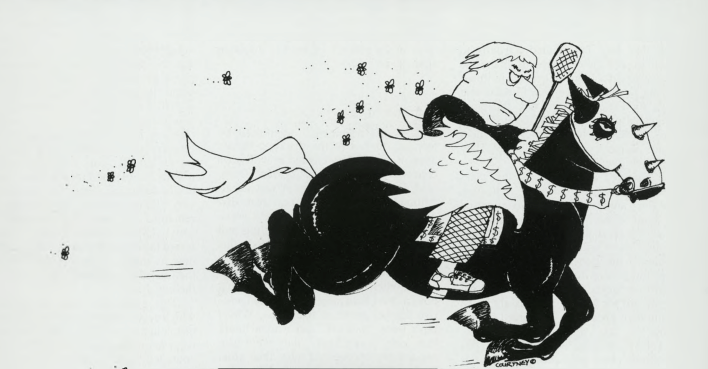
After my dive into the Broadsheet archives, which in all honesty revealed very little for the project that initiated it, I wound up with somewhere in the vicinity of two to three dozen pieces that caught my eye for republishing on the blog. That will become a task for in between more pressing projects, something to tide things over while I work on other things. I intend to do the same for other now defunct periodicals. However given the ready accessibility of the Broadsheet archive, and a near complete physical collection I happen to have access to, it simply makes sense to continue working on such readily available material. This pair of articles, one an interlocutor on the other, caught my eye because the role of the “New Age” has been a troublesome one for the feminist movement over the years. It has been subject of both searing critique, as in the first article here, and ready embrace, as in the second. Specifically the first article is an interrogation of New Age philosophies and programs as an extension of the logic of the New Right, the second a defense of the New Age as a potentially liberatory framework for women. While I skew very heavily toward the former, and would otherwise post it as a valuable critique in its own right, in the knowledge that the response existed I felt it more honest to post the two together even if I openly favor one to the other. Further I think this article and its response highlight one of many tensions within a movement often riven with them, and an often overlooked one at that. It also foreshadows debates in later years, along with the phenomenon of feminist witchcraft in either its literal or metaphorical permutations as a means to discuss the “disenchantment” of the world with the bloody onset of industrial capitalist modernity. So while I very much side with Fitchett and think her article is worthy and even timely today on its own terms, I think situating it within a wider debate in the movement in the form of Dodson’s response gives a fuller picture of how the movement overall grappled with this particular issue.
Brave New Age, Right? (Broadsheet #163, November 1988)

Before I was eight we lived on Baraud St, Lower Hutt. At the end of the street was a chapel. Every Sunday afternoon there was an “open to all” film show for children and a sweet handout. I think us Baraud St kids went for the sweets, but I do remember those sing along movies where the moving ball would hop from word to word – songs like “I’m h-a-p-p-y, yes I’m h-a-p-p-y, I know
I am, I’m sure I am, I’m h-a-p-p-y.” There was such a certainty of faith, a radiant sureness, in the chapel songs and maybe in all our lives. Then the world was predictable, as heaven was for those who believed. My father didn’t believe but we
still had our three veg and meat dinners like everyone else.
Somewhere between then and now a certain/predictable world had disappeared, been eroded by nuclear fear, a diminishing standard of living, a fragile environment, life threatening mutant diseases and the shredding away of traditional economic structures. The “now” world could be transient and is chaotic. The French sociologist, Durkheim, identified such times as ripe for “anomie,” meaning “lack of usual social and ethical standards.” A vacuum/void to be filled. I think about this a lot as I try to make sense of the plethora of new “certainties” springing up in the last two decades. I hesitate to divide them into religious and secular as today the edges of the two areas are very fuzzy. The certainties of faith and philosophies emerging are, however, as clear-cut and razor sharp as the faith I rubbed shoulders with as a child. What is different is the totalness of the new faiths, which bring together disparate parts of the social system – economics, spirituality, personal development, lifestyle and politics.
I keep getting a flash of one of those early socialist films from the USSR: a smiling mass of people, maybe holding hands, marching, banners flying, music stirring in the background, moving forward to a vision. The film might be called The New Age….
…….But wait. Stop the cameras….
…a number of people have been left
lying on the ground … not a backward
glance from the mass moving forward….
Are they dead? … Wait….
…The cameras roll on.

It is time to examine the new Faiths. Psychotherapies and personal self-development have always had lots in common. Fads come and go. When I was at university the Big Thing was encounter groups. We students were offered a cheapie (part of a monster group) at Campbells Bay with Bert Potter. (Bert Potter was once an insect exterminator with a poor reputation.) It cost us five dollars each and Bert focused on the higher-paying non-student group members. Recently the “in” things have been NLP (neurolinguistic programming), rebirthing, provocative therapy and family therapy (strategic or structural). The best from each is garnered out by the people-workers for their own skill cocktails.
Up until recently the group fads (as opposed to one-to-one therapy) have been limited to Centrepoint (Bert Potter) and psychodrama. Other American bignamers such as EST (Erhard Seminar Training) never took off here in the seventies.
Then in 1983 Walter and Gita Beilin introduced the first Self-Transformation (ST) course in Auckland and the avalanche of the self-growth movement had arrived. ST was quickly followed by The Forum (Werner Erhard’s EST wolf in sheep’s clothing). The Life-stream Seminars and Sondra Ray’s Loving Relationship Training (LRT). The latter had grown out of the rebirthing movement. These movements see themselves as part of the “self-growth” field rather than therapy, trying to attract the “healthy” as well as the “not-so-healthy”.

AND the milieu, the soil these groups found themselves in? There were of course the uncertainties of the present world and also people were starting to question traditional ways of healing themselves and staying healthy. Psychiatrists and doctors were under attack from complementary health and natural healing methods. Already gaining respectability were naturopathy, reflexology, massage, homeopathy, herbs, osteopathy and acupuncture.
The mid-80s saw many new complementary health methods – touch for health, polarity, floating and crystals. There was a realisation that the health of the body could not be separated from the health of the mind and spirit – holistic health. There was an acknowledgement of indigenous people’s healing skills and cultural issues. Alongside people looking for new ways to stay/become healthy were people searching for new spiritual certainties.
In the 60s this search had been tied to drugs. In the 70s/80s the search had either gone full circle back to a barren fundamentalism (back to basics) or sought answers in other cultures (eastern gurus) and other times (the ancient spirit voices of Lazarus and Ramtha). Somebody seeing links between the new body work, the new mind work and the new spirit work coined the
concept The New Age.

New Age thinking has developed to the point where it can boast its own media in Australasia. The March issue of Australia’s Unicorn includes articles on: Profitable farming Without Chemicals, Crystal Enlightenment, Conversations With A Dolphin, “I want to be happier” and The Laughing Lama. There is also a small piece on peace and Aboriginal politics thrown in for good measure. Aotearoa has Alan Carroll’s Whole Health which has more natural healing content and less politics. Both journals advertise groups like Self-Transformation and therapies like Rebirthing.
The interweaving of body, mind and spirit is evidenced by, for example, the inclusion of a natural healing advertising flyer in the Self-Transformation broadsheet called Towards Mastery (March 1988).

Among the self-growth movements, ST is different, born in Australia, not American, it has permanent centres in Auckland and Wellington and it is probably the most successful of the movements in this country. (See Broadsheet 127, March 1985, page 26, for one woman’s experience of ST and an interview with a group leader.) ST – recently renamed The Walter Beilin Partnership Ltd – offers a number of courses/seminars. For example, “The Inner Journey; a woman’s workshop (This workshop creates an opportunity for you to embark on a journey to discover, understand and experience yourself as a woman.)”
Once upon a time you had to complete the ST basic seminar before moving onto others, but recently that has changed. Some courses, like “Best” (where “service” to others is explored) are seen as more advanced. Prices range between $250 and $1400 (eight day residential). Like Centrepoint’s regular brochure, Towards Mastery advertises new courses and like the Christian women’s magazine Above Rubies it publicises successes, as in “Turning point – family style”. At the basis of its courses is the concept of Personal Choice.

The Forum does not have a broadsheet, it has a prospectus – glossy paper and all. There are a lot of photos, all of people who are white and middle class. The first photo is very telling: two white business men (complete with attache cases) smiling largely at each other, are crossing a road. Behind them a well-dressed, smiling white woman is getting our of the back door of a car. On the pavement behind the car is a white, heterosexual couple.

Walter Erhard was/is a salesman. The Forum prospectus sells “an exceptional opportunity” to gain “access” to “being” (being effective, creative, competent etc) to the “already…successful, healthy, committed, accomplished, knowledgeable.” It claims it is definitely not a new belief or philosophy. The cost is $475 for a 50 hour course. The Forum does attract the successful professional, time and time again. We all know at work when our medical officer has had another “hit” by his beaming smile and evangelical manner. Corporations like Chase are sponsoring top executives to the Forum.
LRT (Loving Relationships Training) with its emphasis on relationships is at trading quite a large number of women students. Their weekend seminars cost $430 plus. The emphasis is on people taking responsibility for themselves and course strategies include rebirthing breathing techniques.
Life Stream seminars is the latest big import from the US. The content is again personal effectiveness but the style is more low-key, similar to the way courses are traditionally run in this country. A seminar costs $440.
From a self-growth point of view these movements/courses have similar goals: to help people get in touch with their potential, learn new inter-personal skills, enhance their lives. Despite The Forum denial they all have a certain philosophy and certain premises. Some, like LRT, have minimal premises – people can develop their potential, control their lives. The others have more complex premises with a moralistic tinge. One general premise is that it is okay to have and to want to have and if you choose to you will get what you want. Self is justified, individualism is justified.

Another premise is that we create our own reality, we choose where we are, what we are in the world, therefore we can choose to be happy.
Both Self-Transformation and Rebirthing (LRT) go one step further, adding a spiritual aspect by colonising the concept of reincarnation or “karma”. We chose the events happening to us in this life before we were bom, thus working out the lessons of the past in our present life. This colonising angers a friend of mine who is a woman of colour. She sees the use of the “karma” concept as inappropriate and lacking in understanding and compassion.

Another “spiritual” premise is that self-change /self-transformation will have a profound effect on the world – inner peace, world peace.
As with any philosophy/system of morality there are winners and losers, sinners and saved. The winners are let off the guilt hook. Who are the winners, the saved? They seem to be mainly white men, financially secure and employed. Aren’t they the ones who “choose” these things most often in our society? The losers are women, Maori, the differently abled – in fact any minority group who are being told to pick up new guilts for having “chosen” their powerlessness. Guilts that we have taken decades to throw off, to get rid of, so we can feel worthy. Told to re-shoulder their problems, the powerless are made to feel bad about expressing justifiable anger. Instead they are told they should feel love and acceptance of their choice – sexual abuse, discrimination, redundancy, prejudice.
None of the self-growth movements have as a premise the necessity to be charitable, Unlike in Christianity, there are no rewards in heaven for the compassionate. However, ST has one advanced course (Best) where students are “put in touch” with the concept of “service” and Erhard of Forum has a hunger campaign where no money goes to the hungry.
Forum philosophy goes as far as to imply hopelessness for those who are not already successful – “what is, is, what ain’t, ain’t” and better luck in the next life.
This apolitical “I” with the thumbs up seems at odds with “sharing”, the collective “we” unconscious the New Age is supposed to promise. However this new “I” fits very well (it’s tailor-made) into a new economic climate. In America corporations prefer Forum graduates, who are “industrious, obedient and accepting of the status quo”. (Metro, p80). “Taking responsibility for oneself” are the crywords of monetarist Milton Friedman, right-wing philosopher Ayn Rand, National MPs Simon Upton and Ruth Richardson and others of the same ilk. I tried to borrow a copy of Ayn Rand’s book Selfishness Is A Virtue from the Auckland Public Library. They found that their only copy (housed at Epsom) had been stolen. Someone, somewhere is no doubt advancing their excellence. As Simon Upton succinctly puts it in his book The Withering of the State:

A “free society” is where individual liberty is maximised, where excellence is shown in the accumulation of wealth and charity will trickle down to the disadvantaged. New Agers share the same hope for self – development. Whole Health‘s Allan Carroll believes “the self-development process will filter down from the middle class into society as a whole.” (Metro) Should we even care if there is no trickle down/filter down of knowledge, goods and services to those on the bottom of the heap, those learning this life’s lesson? Let’s not stop them in their path towards enlightenment.

There are other premises free marketeers and self-growth movements have in common:
- The interests of the individual are the same as the interests of society as a whole. This assumes that; individuals are always rational in relation to their self-interest; that an individual’s preferences and desires are independent of others’; that “normal” people are never dependent; that collectivism is false, we live as individuals (ST and Forum particularly).
- We must concentrate on scarce human and physical resources, putting our energy into the “successful” and using resources even if they are not renewable. Help for the “non-successful” (abnormal) should only be a safety net, not a right. (Forum particularly).
- Profit (money) is the only motivator – thus the entrepreneurial wealth-makers are the valuable individuals (Forum).
- People can choose freely and the most free society consists of consumers choosing in a climate of competition. (LRT – rebirthing – and ST particularly).
- All people can afford to be consumers and paying users. (Note particularly the cost of self-growth movement courses.)

As more and more feminists are attracted to the self-growth movements and a number are returning to “normality”, that is, back to the nuclear family, back to heterosexuality, is it possible to winnow the chaff from the grain, get what’s good from these movements and dump the apolitical, the reactionary? On the positive side the self-growth groups are teaching skills and imparting confidence. A smiling woman acquaintance approached me on a Ponsonby street. “Isn’t it great,” she said. “Women (feminists) are so positive nowadays – friendly, getting good jobs, buying houses, improving themselves.” It is great women are improving themselves in terms of the world’s resources (or is it only white women?) but reading between her lines I heard a judgement on past political challenging and questioning. The sub-text is that these things were/are not positive like buying houses and so on.
I am not about to put down caring for each other, but what if the New Age package makes us blinder by the moment?
Blind to the woman who rang me in crisis during my duty day at work. Acutely distressed, she was in the middle of a rebirthing course. At three years of age she had been sexually abused and during the course she had been told she had chosen that abuse, the new guilt had broken her.
Blind to the myth of our “freedom to choose”.
B F Skinner enraged Ayn Rand with his book Beyond Freedom and Dignity. He questioned the American Dream that capitalism equated with freedom. Skinner dared to suggest that while totalitarian states controlled/coerced by aversive means, capitalist states coerced via reward in the form of profit, and class divisions which wrote off more than half the population at birth. B F Skinner’s passport was taken off him by the American government.
Free marketeers, New Age and self-growth movements do not at any point address the question of power – who holds
it and who will continue to hold it – or suggest this should be or could be changed, nor how. A successful woman has to be a Superwoman, a successful man has only to be white.

By their very nature, profit and success distort choice, distort belief. Choice is distorted by things like the building up of coercive multi-nationals which control large chunks of profit and resource availability. Persons in positions of privilege display ignorance of the real conditions of the lives of people who are disadvantaged and have unrealistic beliefs on how people can manage. (Upton and Richardson).
The new Faiths do not address the issues of who has access to information, who has access to the market or whether this access is equal. Free marketeers (like Treasury) trot out out-dated, fallacious concepts such as a “socio-biological” concept to explain compassion and charity. Compassion, empathy and co-operation are learned behaviours. The Laissez-faire philosophers are correct in one way – as babies, humans start off self-ish and self-centred. But no species has survived as solitary individuals. Also, we are all dependent at some point in our lives – as babies, in illness and accident, and when we are very old. While individual and societal interests often conflict, individuals cannot, by themselves, build the Sphinx, prevent the further pollution of the sea, or be an orchestra. Solidarity is essential.

On a more sinister note, there is some evidence of types of self-improvement courses (not necessarily the ones mentioned in this article) being used in South East Asian countries to de-radicalise an activist population by making people happier, more self-content and skilled: their cynicism, their dis-satisfaction will be neutralised. What a plot for a novel! The secret agents from a large country want to pacify a population which contains a number of stroppy activist groups. If the agents bring pressure to bear for the suppression of these groups, they will stick their toes in and fight back. Why not alter their inner belief structures and attitudes instead, by attracting them to and selling them programmes that advertise a better quality of life and self-enhancement but which include underlying premises that oppose group solidarity, helping others and the possibility of change. And also lay on a huge layer of guilt if you are not “making it”. Step aside Graham Green.

In Huxley’s Brave New World characters were blissed out on Soma, oblivious to the pain needs of those around them. They were more interested in their own experiences, their own excellence. As I have argued above, the philosophies of the free market, aspects of the New Age package and the self-growth movement have a lot in common. All provide a ready-made, apolitical (or more sinisterly anti-political) potion for just the same sort of navel-gazing, oblivious to the possibility of a (dead?) planet littered with the remains of the “non-normal” the “didn’t make it”: women, people of colour, lesbians, gay men, gypsies and Jews.
CUT
…a number of people have been left
lying on the ground … not a backward
glance from the mass moving forward….
Are they dead? … W ait….
…The cameras roll on.
CUT.
Another “New Age” (Broadsheet #168, May 1989)

Some of us love them, others hate them – the so called “New Age” philosophies are certainly a popular conversation topic at the moment. But what does New Age mean, is there a New Age, and can there be one before oppressions are redressed?
For many women it is difficult to reconcile the individualistic base of many of these philosophies – philosophies like Forum, Loving Relationship Training, Erhard Seminar Training, and other less formal ideologies – with a feminist analysis which views oppression as a societal responsibility. A New Age worldview advocates an internal quest for individual betterment, while feminism seeks to change structures as much as attitudes. On the other side of the fence there are women for whom New Age spirituality is a useful tool in their lives.
What follows is a response from Cushla Dodson to Sue Fitchett’s article, “Brave New Age, Right?” which appeared in Broadsheet, November 1988. While Sue Fitchett sought to provide a critique of New Age ideas, comparing them to capitalist and right-wing philosophies, Cushla Dodson writes from the perspective of someone who is involved in the “New Age”.
A) It is new and we are not too sure about it so it must be bad or at least very suspect. Let’s pull it to bits.
B) It is new and we are not too sure about it so let’s gather as much information as we can and make some decisions of our own.
Either of these approaches can be applied to innovative modem music, art, philosophy, education methods, nutrition systems, political analysis, child rearing practises, or any other aspects of newness in our lives.
Approach A blocks any potential for growth and learning. Approach B opens opportunities for discovery and understanding. The “New Age” has been at the receiving end of much Type A attention (even in Broadsheet). I am seeking to present my own New Age viewpoint as fuel for furthering a Type B exploration.
What is the New Age? It is almost easier to say what it is not: it is not religion in drag, it is not an easy way out with all the answers provided, and it is not some manipulative monster dreamed up in California. It’s not a movement created by eastern mystics either – so what is it really?
The “New Age”, “Age of Aquarius”, “The New Spirituality” is an astrological timing in the planet earth’s evolution, a time of new and different planetary and stellar influences which have never before been experienced, it is also a time in the evolutionary cycle of human kind when people are more able to consciously reach beyond the limitations of survival existence (physical and emotional) to the metaphysical and spiritual potential of human existence. Our thinking process is vastly different from that of 3,000 years ago, our brains are no longer “programmed” and passive receivers, they have evolved into the tools with which we shape our reality. The old scripts that have prescribed the human condition are running out and/or are no longer appropriate. Individually and collectively it is now up to us to consciously (with full awareness) create new scripts – scripts for our shared future. The New Age is evolving thought, quantum leaps of vision and understanding. For some it began hundreds of years ago, for others it is far in the future, for most the time to become part of the newness is now. As the Goddess energy re-emerges we are more able to tap into the feminine, conceiving energy, imagination and intuition to perceive the way ahead and to redress the imbalances of centuries of patriarchy and chauvinism.
The Civil Rights Movement, Feminism, the Peace Movement and Environmental Organisations were, at their beginnings, imaginative New Age initiatives, consciously creating new awareness, planning new visions, new ways of observing and carrying out their plans for a better world. Their philosophies were New Age and despite the blurring caused by old reactive conditions they have been significant contributors, at the leading edge of change.
If we dismiss the New Age – without careful consideration then we dismiss and invalidate our years of participation in social and political action – we joined up in order to activate the dream didn’t we? Most of us got caught up in the struggle, we were (then) unable to create something completely new and the old ways didn’t mesh fully with new thinking. Disillusioned and debilitated we left the “movements” in droves and began the search for something to fill the gap created by the giving up of our hopes and
dreams. Most of us were convinced that the world could indeed be a better place “if only” – and many focused that “if only” on their own shortcomings and became easy game for the false prophets offering salvation, warmth and “community”, in place of struggle and hardship. Good people who we had loved and thought we understood became lost to us behind a cloud of what appeared to be self-serving, self-centredness and incomprehensible jargon. New Age began to be two dirty words.
There are charlatans cashing in on our need to fill the gap and/or feed our search for knowledge, our desire to re-kindle the sparks ignited by our political hopes and dreams. The false prophets call themselves New Age – they are not! It is the behaviour not the label that identifies New Age thought and action. All the groups and individuals wearing the New Age label are not necessarily ambassadors for clear new thinking and the special qualities of true New Age creativity. For many New Age is a convenient and popular bandwagon – a label to tack onto old or re-cycled ideas (or newish manipulative or scary ideas.) How can we tell the “true” from the “false” when the labels are jumbled or phoney?
Any philosophy that advocates accumulation of resources at the expense of others or with disregard for impact on others is not New Age. “For the greatest good” is not enough. “With harm to none” is the New Age baseline. Any system, therapy, movement or philosophy that encourages dependence, supports or ignores the plight of powerlessness, presents scenarios where human kind are helpless victims of greater forces, or in anyway denies the right of individuals to create their own destinies is not New Age. Power
over anyone or anything is out for those who seek the balance of dominion rather than domination – no matter how new a concept or technical advance may seem to be if it fails to work in concert with every aspect of the environment, living and non-living, it must be a relic of old thinking. (Windmills are more New Age than nuclear reactors, Bach flowers more New than open heart surgery).
There is no one way or right way to participate in the excitement and growth of the New Age. If we exercise our choices with discernment there are a wealth of resources available. However, no one resource offers all the answers or even all the questions. It is up to each individual to create her own unique pathway taking full responsibility for her impact on others. There are no rules and mistakes are permissible. Love, Fun and Growth are key words and spiritual curiosity imperative. If individually we are able to uncover the resources, love and support that we need we can build safe, loving and supportive communities where more and more people can be free from the tyrannies of old thinking. As each of us steps across the new threshold we create a blueprint for all those who are seeking the future in an abundant and caring world where equality and peace are the norm.

 Notes South from Nowhere
Leave a comment