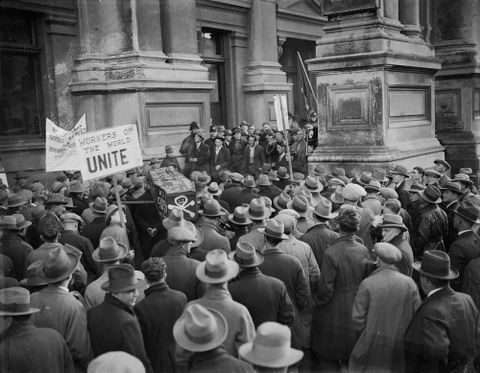
The following are some notes related to a somewhat impromptu talk I gave at the first annual Otago Politics Day School in August entitled The Modern Socialist Left in New Zealand: Its Current State and Political Composition. Because the talk was organised a little on the fly, these notes are somewhat structured but are still rough notes which I’ve put together into a more article friendly format. The notes largely comprise of my thoughts on the political and organisational composition on the socialist left today, how it reached this point, (dis)continuities with the historical socialist left, and some of the possible trajectories this may imply. These are simply some personal musings and hopefully a few points arising thereof that prove helpful to those who read this.
At first glance, the socialist left constitutes around 200-300 people scattered between at least 22 organisations which include traditional political organisations, infoshops, publishing collectives, loose networks and media outfits. The numbers can change in either direction depending on how broadly or narrowly you define socialism, who you choose to include or exclude. A little broader in defining the type of organisations included, or expanding ‘socialism’ to encompass the entire ‘radical’ left, and the picture appears a lot rosier in outlook but much muddier in content. Cut the definition too close and some important organisations or figures may be left out. So, while the number and composition could be argued endlessly, I will stick with the above given figures for this ‘article’ when talking about the socialist left and will refer to the radical left when talking more broadly about ‘everything left of parliament’.
Politically I believe the socialist left can be categorized into three tendencies: the Trotskyists, the Anarchists, and the Pluralists (with a couple outlier exceptions to prove the rule). The first comprises of somewhere around ~8 organisations, depending on whether you include Trotsky-sympathetic or ‘post-Trotskyist’ organisations. Most of them are aligned to their own distinct tendency within mainline Trotskyism. However, it’s worth noting that both the International Bolshevik Tendency and the Communist Workers Group are descendants of the New Zealand Spartacist League, and that both Socialist Aotearoa and the International Socialist Organisation orbit the International Socialist Tendency with the former being its official affiliate in New Zealand and the latter an unofficial observer (closely aligned to the now defunct American ISO and the very much alive Australian Socialist Alternative). The youngest of these groups (Socialist Equality Group) is somewhere in the vicinity of a decade old, Socialist Appeal and Socialist Aotearoa (itself a Socialist Worker split) are closer to 15 years old. Several of these groups tend to be older, more than half were founded pre-2000 or the result of internecine splits and expulsions from earlier groups. The eldest of these groups, the Communist League, is over half a century old.
The point being that while some of the organisations are on the younger side, and some have a younger membership thanks to a higher throughput of activists, overall, this tendency trends toward legacy organisations which prove durable over time even if they seem to have a fairly hard ceiling for membership. As such, it’s hard to know whether the durability of the organisations or the inability to grow beyond a cap of perhaps 3-4 dozen members at most will win out in the medium- to long-term. The problem of either an aging membership with high retention or younger membership with low retention may continue to plague the Trotskyist organisations, proving to be an eventual death knell for some. This is not to say an organisation always has to be growing to avoid extinction, but that it does need to at least be able to retain some younger members in the long-term to replace aging members retiring from political activity one way or the other. This does not have to be a central imperative that drives all activity and can be (indeed is likely best) a patient process undertaken over years through other activity. This is not something the organisations in question don’t know, but it is an issue nonetheless. There is something to be said for the durability these organisations have fostered. The elder of these organisations have weathered some disastrous slumps in fortunes and endured, a commendable feat to be sure. It remains to be seen if that durability will pay off in terms of growth or a greater degree of influence in more optimal periods of social struggle. Despite changes to industrial relations law and some gains made by the labour movement, social struggle remains at an historic low when considered alongside the soaring peaks of the ‘offensive wave’ of the 1970s and the ‘defensive wave’ of the later 1980s.
Onto the Anarchists, we find another tendency which has seen better days. Quantifying the Anarchists has always been a fraught game as they have long tended to fairly loose forms of organisation with projects appearing as needs or fancy dictates. Of the ‘main’ body of organisations considered above, the Anarchists account for around ~6 of them. These take widely varying forms when compared to the Trotskyists, for whom organizationally they all appear quite familiar. The Anarchists by comparison vary from largely organised online to largely in person, from being centered around a physical space to a more familiar activist model, and as established central organisations to operating as a small ecosystem of generally Anarchist-led projects. Age wise the older projects date to the 1990s and 2000s, while the youngest project (Tāmaki Makaurau Anarchists) only barely predates the pandemic by a year or two. While the Anarchists have a number of legacy organisations, they also have a greater degree of experimentation which leaves behind defunct organisations when those projects don’t pan out. Much like the Trotskyists, the Anarchists’ fate is tied to the level of social struggle in the wider society. Both had their best period over the last 25 years during the anti-globalization/anti-war movements of the early 2000s (which, it need be said, coincided with a small bump in labour unrest), and both experienced a slump when those movements disintegrated in the later in the 2000s. While there has been a recent uptick in labour unrest, social struggle on a whole remains fairly low. The greatest signs of social unrest have come, in rather spectacular fashion (for a few weeks anyway), from the right. An analysis of the organizational composition of the radical right, however, is for another day.
The Anarchists in one city, Dunedin, remain closely tied to a physical space in the form of Black Star Books and related projects. The necessity of space has been a factor for the Anarchists for some time now, with the growth of infoshops and bookstores in the 1990s leaving behind two of the most important institutions for the national scene: the aforementioned Black Star Books in Dunedin and The Freedom Shop in Wellington. If one also considers the (now defunct?) A-Space project run by the Tāmaki Makaurau Anarchists, it seems that the need for a physical space remains a pressing one to anarchist strategy in New Zealand. It might be said that while Trotskyists and other descendants of the Leninist tradition operate within the bounds of coherent organisations, often styled as party or pre-party formations, the Anarchists operate as communities of shared activity. Those communities are defined more by a constellation of related projects which could be considered Anarchist led or influenced, with the overall effect being a diffusion of Anarchist ideals across the projects but each project only being one node of activity related to perhaps one or two explicitly Anarchist projects. Hence, we might see Anarchist influence in a number of projects bounded by geography with the activists in question tied to a ‘central’ project which defines itself in explicitly Anarchist terms but not seeking to push that project within the others (perhaps for fear of the appearance that other projects are mere front groups). A benefit of this strategy is that Anarchist ideals might be spread well beyond the bounds of the fairly small number of overt Anarchists operating in a scene at any one time, allowing small groups of committed activists a level of influence belying their actual numbers. However, a significant downfall is the lack of long-term movement infrastructure which gets built, leading to little trace being left of the organisations that fail or otherwise get wound down over time. Indeed, when researching in the field here in New Zealand a consistent headache has been the lack of trace sometimes vibrant and relatively large outbursts of Anarchist movement activity leave in their wake. A further problem is that a high level of activist throughput does not necessarily lead to influence carrying forward over time in the same way the internal political education and discipline of Trotskyist and other Leninist organisations does. This can mean that while the Anarchists might include a large number of people who have moved through their ranks before moving on, it can be difficult to trace any net effect that former participants in the movement experienced for having been part of it. Again, the issue of impermanence raises its head. This matter is a longstanding one, and whether it be considered a problem or utilized as a benefit is down to how the Anarchists interact with this legacy going forward.
The last of these tendencies, the Pluralists, is the newest of the three and the one that is yet to be readily identified as a distinct trend. Arguably their number includes just 3 projects: Organise Aotearoa, the Federation of Socialist Societies, and Rebel Press. Of those, Rebel Press was formerly an explicitly Anarchist project but has shifted to a more ‘radical left’ orientation to match its shift to being a space for other publishing projects to use. Organise Aotearoa, which experienced a spectacular rise in the year or two before the pandemic before slumping to its present state as one among many Auckland based projects, has been honing its own conception of decolonial communism which can work to be suited to the local conditions in New Zealand. It’s a highly commendable if potentially fraught task, especially given the ‘broad-tent’ nature of the organisation. Such a nature is shared by the Federation of Socialist Societies, which bills itself as a primarily educational and social society which aims to provide a forum of mutual learning for those interested in the wider socialist tradition. What Organise Aotearoa and the Federation share is a broad outlook which recognizes that unity can be found on fundamental principles, and that a certain freedom is afforded those detached from the complications of a distinct pre-established tendency. This broadness allays the weight which upholding some distinct micro-tendency can put around the neck of organisations, though it also means the potential benefits and international connections that such a weight confers are also absent. The difference, from my perspective anyway, is that where Organise Aotearoa are trying to forge a tendency befitting the conditions, the Federation act as more of a clearing house and reprieve for the many ‘independent socialists’ and fellow travelers that dot the radical left. Both are laudable goals, in my opinion, and I am quite curious to see where each goes. This non-tendency, which embodies the pluralistic competition of having many tendencies cooperating to keep a single organisation afloat, may well prove to be the future of the radical left in this country or merely a passing fad half-remembered by the likes of myself in a decade’s time.
One thing that is to be said for the Pluralists is that it is not merely a ‘broad-tent of whoever shows up’. The choice to eschew a single pre-established tendency is a conscious decision, and both have a basic but functional definition of socialism which members are expected to at least agree with on principle. The point, as far as I can tell, for the one is to thrash out a distinctly New Zealand flavour of socialism to which people with a general sense of socialist principle or a past in one or another tendency can adopt as a framework for localised socialism in the distinct conditions of New Zealand or Polynesia more broadly. For the other, the point is to act as a central meeting point for a smorgasbord of tendencies with their own legacies and baggage, to be the metaphorical table at which people can meet and argue over a usually literal drink. Both have a distinct and valuable place as far as I’m concerned, as both are trying to do something that many have tried to achieve over the long course of the socialist movement. To find that which works in the New Zealand context and develop theories as to why and what can be gleaned from that fact. The Pluralists aren’t just accepting anyone who turns up but making a point of their pluralistic nature in and of itself. They may come to a point where they have a named and distinct tendency which can no longer be said to be ‘broad-tent’ but a distinct thing in of itself, but for now their pluralism with all the conflict and collaboration that implies is their defining trait.
The exceptions to the rule of the Trotskyists, the Anarchists, and the Pluralists number at perhaps ~6, and crucially several of which are likely moribund. Indeed, those that are showing signs of life and are definitely active projects are those that bear some relationship to the Trotskyists (Redline and Platypus Affiliated Society). They are very much exceptions that prove the rule, either being largely inactive or having one foot in one of the aforementioned 3 primary tendencies. At any rate the point is that on the whole the socialist left conforms to one of these tendencies, and in trying to establish a political geography of the socialist left they emerge as clear trends.
Being able to identify these tendencies is not alone enough for a basis for cooperation (something I was asked about multiple times in as many words when I gave the talk mentioned at the start). The existing socialist left came into being through real experience, it has a real history of real people, and as such there are just as many bitter rivalries and acrimonious splits as any movement generates. These are both political and interpersonal, both navigable and impassable. Some activists are unlikely to be able to cooperate directly together for the foreseeable future, however they may nevertheless be able to act in unison in a healthy movement. What knowing the terrain represents is a step towards that capacity for cooperation. On what grounds can the tendencies and organisations work together, on what projects, is that cooperation more successful than going it alone? In terms of bringing in new people it is generally better to be able to look outward rather than trying to scramble for those undecided or wavering few that slip between one organisation and another, but campaigns and projects in cities where multiple organisations are operating requires the ability to know what the other organisations and projects are doing. Total ignorance of the terrain means unnecessarily expending vital energy on duplicated projects, confusion and infighting within campaigns, and depressing support for doing so. Knowing the terrain does not mean always working together on every project or campaign, but it goes some way to avoiding the infighting and duplication which hobbles activity and expends energy of which the socialist left has precious little of.
This identification and study of the terrain on which the socialist left operates goes in regardless of whether it is done self-consciously as a project. Organisations and campaigns in which the socialist left operates, such as Peace Action or People Against Prisons, are made up of those activists whose regular activity includes navigating the history and present of splits and fusions, fissures and embraces. It is rarely done, however, in a systematic format. It is ad hoc on a case-by-case basis and as needs be. It is therefore a process repeated as new organisations or campaigns emerge with the times. That process can be simplified, rationalised, and done so without dehumanising the whole matter. Indeed, the capacity for cooperation requires a humanization of fellow socialists, that is an understanding of people as more than just units of their political projects. At times the form that capacity might take glimmers into life before being dimmed by time and more pressing concerns, a joint statement by usually feuding organisations, the membership on a single project of people more often at each other’s throats than arm in arm on the picket line, a shared speakers list at a rally of people who’d otherwise scarcely be able to stand in the same room. And likewise, the basis for cooperation is not to be found in squashing these real political and interpersonal differences under a veneer of unity. This is only a deferral for what will surely be an even greater eruption further down the line, creating a pressure cooker effect of dissatisfaction that further attempts to quash will only intensify. It is far better to try understanding the contours of disagreement, and to see whether it can be resolved, avoided, or is insurmountable in the open.
In some cities the existing socialist left is small, or centralised into very few organisations, making the task easier. In our largest two cities, Auckland and Wellington, the socialist left is diffuse and spread across a constellation of organisations, making the task harder but perhaps all the more pressing. What can be said is recognition of the terrain will ease the process of expanding the socialist left, of establishing the movement infrastructure needed to accommodate that expansion, and crucially to bringing the clarion call of socialism to a broader mass than the socialist left has been capable of in some time. Whether or not this takes place, and how the terrain of the socialist left will change, is yet to be seen. It can only be identified once it happens, as it were, and so too can a new terrain only be mapped when there is a new terrain to map. These notes bring forth one cleavage through the political terrain on which the socialist left operates, they add one layer of detail to the map. Further cleavages exist, it remains to find them and complete the picture.

 Notes South from Nowhere
Leave a comment