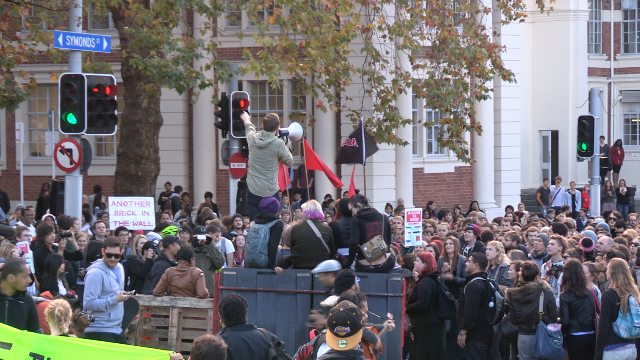
This article was originally written way back when the blog was launched in 2017 (I’m reasonably sure I penned a draft even earlier while in undergrad), but has slowly migrated – mostly finished and entirely unpublished – across laptops, USB sticks, and hard-drives for close to a decade. While revamping the blog, I stumbled across it clearing out drafts and abandoned projects, and to my delight found that although it needed some serious editing that I largely agreed with the main points still. The main matter at hand is that it is somewhat less immediately pressing today, in a time when the largest socialist organisation is largely not composed of students or oriented around campuses, and when taken as a collective whole (that is to say, as a political movement rather than a scene comprised of individual and disconnected organisations) the socialist movement seems to have a more balanced social composition than it did in the mid-2010s. Nevertheless, I figured, given my return to campus as a PhD student, that there’s no real reason to leave this already almost finished article unpublished. I have expanded it in several places, especially in contextualising the historical economic conditions of ‘the student’ in post-war Aotearoa, but the core arguments remain largely the same. At a minimum it serves for myself as a refresher on where my thinking was and where it has come, and also as an intervention on a question with enduring relevance even in times where it is less immediately pressing.
Questions of where exactly students fit into the socialist movement have been bandied about since the New Left era. That period is now approaching 70 years since its inception, as the initial murmurings of campus political radicalism and specifically a newfound interest in socialism began roughly in the mid-to-late-1950s (in Aotearoa as well as elsewhere). Posing political questions regarding the position of the student in the socialist movement may at first conjure up the halcyon days of the late-1960s and early-1970s, for Aotearoa as for elsewhere, but it is really after the end of the Cold War that it becomes one of the dominant questions for the remaining socialist movement to grapple with.
While the campus erupted as a site of struggle in the New Left days (at least, more so than it had in previous upsurges in then-recent memory), it was in the context of a youth counterculture which crossed class lines and included many who either never went or only briefly engaged with the tertiary education system. It also emerged in the context of an unprecedented influx of new students from working and lower-middle class backgrounds, as the economy experienced a sudden need for huge numbers of better educated waged workers (whose remuneration could in some areas be substantially higher than expectations of even just their parents). This is all to say that the student uprisings were in a specific period in which huge numbers of students were the children of working and lower professional class backgrounds. These were often working class kids who were the first or among the first members of their families to formally engage in tertiary education, and especially so at universities.

By the 1990s, however, this trend had risen and subsided as economic changes began the long process of retreat from the scale of skilled labour needed to satiate the labour market. Being “a student” by this point had become as much a routine rite of passage on the way to entering the formal economy (and a respite from poor job prospects during the long tumultuous years after the Black Monday stock market crash in 1987). The ‘class shock’ of the prior sudden influx of working class students with their newly heightened expectations of social and cultural mobility had been diminished by rough economic conditions in the 1970s and 1980s, as well as the decline of the vibrant social movements which emerged over 1968-1981. This paired with an historically high level of industrial militancy that was overwhelmingly defensive, as workers fought tooth and nail against huge numbers of job cuts with the deregulation of the national economy.
So, by the time of the end of the Cold War in the late-1980s to early-1990s, a confluence had emerged of circumstances which primed the socialist movement for cementing an extant drift to the campuses. This confluence consisted of a major decline in the industries which had previously housed large numbers of politically conscious and militant workers with a tertiary education system which had become normal for a much larger segment of the population and also was acting as a temporary escape hatch in the context of a severe recession. With many socialist militants in the waged economy now on the backfoot and facing the prospect of either unemployment or lower paid work prospects, and a highly energetic movement of angry students building on the campuses, the situation was perfect for an explosion of campus recruitment.
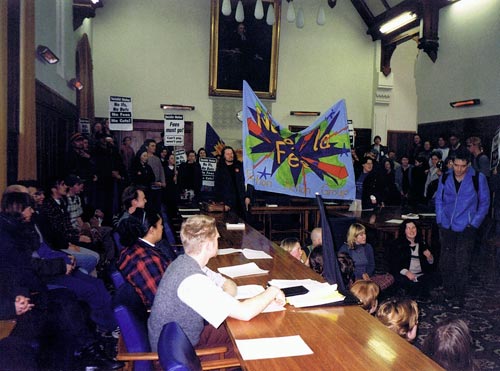
We can see from here why much of the socialist left focused on the campuses in the 1990s, especially when we recall the waves of student occupations and mass protests which roiled most major campuses repeatedly throughout the decade. Several organisations, not least of which the newly formed International Socialist Organisation and Socialist Worker (formerly the Communist Party) before, during, and after their ill-fated merger and resulting split, did well during the high watermark of the 1990s student movement. However, the die was cast for the major players of the socialist movement, who over the coming two decades would lean heavily on campus organising to recruit and (in my opinion) fell into unhealthy habits for it.
Through the late-1990s into the mid-2010s, three main organisations became the dominant players among the socialist movement (alongside a more amorphous if numerically larger constellation of anarchist projects). These were Socialist Worker, the International Socialist Organisation (ISO), and what would eventually just be called the Workers Party (which went through many organisational and name changes over the period). Between them were somewhere between 90-150 members at any given times depending on the fortunes of the individual groups involved and the wider movement as a whole. These groups, though not totally, recruited significant numbers of students and committed a decent amount of time and energy to the campuses over this period. Although this was more pronounced in the ISO than Socialist Worker or the Workers Party, its fingerprints are not hard to find in the latter two (consider for Socialist Worker several key younger members emerging out of the student movement of the 1990s and early-2000s, or the dominant position of the Workers Party in Victoria University student politics across the decade).

This in and of itself is not a problem, what is not being argued is that the campuses should be ignored. But problems can, and in my opinion did, arise over time. It is worth dealing fairly to some of the justifications for a campus orientation before reaching the critiques which might be levied at such a strategy. The basic justification for this model that has been expressed to me over years of discussions with current or former members of all three organisations are as thus:
Campuses provide a relatively cohesive body of young people with a direct material interest in some progressive economic and social reforms. This interest is paired with the comparatively greater free time an undergraduate student is likely to have compared to a full-time worker the same age, allowing aspiring young leftists to devote far more time to activism and political work. In present conditions increasing numbers of students are working to supplement their income as state loans and benefits are left to falter behind rising costs of living [note from today – previously this specified housing and study related costs such as textbooks and fees, but today I would add groceries and energy bills given steep rises in both over this decade thus far]. This increased mixture of work and study during semester time can potentially form a strong basis for student support for working class struggle and vice versa, with working students acting as the conduit [note from today – for whatever reason the draft of this article did not draw the connection to Unite Union and its effective use of outside sympathetic activists, however this is the main example which has been repeatedly impressed upon me and I concur it is a vital case study for the argument]. The potential exists from there for solidarity committees and other such bodies to emerge and form the nucleus of an expansion of political activities and more widespread radicalisation.

Campus organising is, therefore, a good way to recruit young potential comrades and give them experience in socialist political activity (and preferably become long term members of the organisation in question). And even if these comrades leave the organisation, that socialist political experience is brought with them into the wider social world where it can be the basis for future political work. Furthermore, as working class struggle as measured by industrial unrest has declined significantly and never fully recovered from the 1991 Employment Contracts Act, eager students provide a vital opportunity for socialist recruitment in periods of significant downturn and the need to consolidate available political power and experience.
This isn’t necessarily all wrong. Indeed, many of the positives are real positives. Many will experience the starry-eyed activist phase in undergrad (I certainly did), indeed this is much more common now than when I was in undergrad. Though it should be noted many will never really formally join an organisation or party (as I, at the time, did not). Despite vastly increased study workloads compared to over thirty years ago (the counterpoint to the potentials created by greater numbers of students doing part-time work), undergrad students still have far more free time than full-time workers. This institutional basis on campuses provides an added benefit to organising, hosting meeting or events is substantially easier when free rooms are often available. Likewise the layout of campuses funnel the movements of people who work and study in such a way that propagandising through stalls, posters and leafleting is far easier. Large numbers of people need to move past walls, noticeboards or columns on a daily basis, and where many large-scale employers no longer operate in such a way as to facilitate propagandisation on shift changes, the university is structured such that doing so is possible between lectures.

There are, however, among other smaller issues, two serious drawbacks that I wish to highlight as potentially deeply deleterious to the wider socialist cause. The first is in the character and class location of ‘the student’ themselves. Mass student membership in an organisation, especially where there is a relatively weak or loose political education program, can serve to create a situation where the social base of the organisation is founded on a social group with a class location that is by nature transient and unstable. It can have a ‘tower set in sand’ effect where constant effort must be expended to shore up the organisation as members naturally move on with their lives and shift geographically as well as socially. A small core may stick around, but membership retention may resultingly be artificially high as a result of the geographic transience and class mobility of the social body being recruited from.
This could produce a tendency to cover up deeper analyses of class and other social divisions within the ‘student body’ so as to avoid inconvenient or messy questions which threaten the ‘tower set in sand’. Part-time student workers during semester, full-time student workers between semesters, unemployed students with low support and potentially varying access to state welfare, unemployed students with high support or otherwise access to wealth to supplement income or offset emergencies, all may exist within the organisation with different motivations and material incentives to be involved and these incentives may not all be harmonious with one another. The class background of students through their families or support networks may vary even within the organisation, and failing to analyse or papering over these latent divisions can prove disastrous.
Furthermore, a focus on building the organisation through student recruits can in turn result in the focus becoming organisational building in and of itself. The ‘tower set in sand’ requiring constant recruitment to supplement aging, moving, or otherwise leaving student members. The effect is that undergrads become burned out in the process of keeping the organisation alive, as recruitment supplants medium or long-term political goals as the goal unto itself just to keep the organisation moving. The resulting circuit of propagandise-recruit-build-repeat both produces a low membership retention rate while it warps the political objectives and strategy of the organisation. It may be near indefinitely self-sustaining, but interventions in all levels of politics easily degrade to becoming opportunistic without clear goals beyond further recruitment to keep the foundations of the ‘tower set in sand’ from crumbling beyond repair.
At its absolute worst, the organisation can become more of a pyramid scheme-meets-merchandise store, in which student activist work as effectively unpaid labour to keep the whole operation afoot without ever really interrogating what the next step beyond the continuous recruitment drive is. Such an accusation has been levied, in my opinion both fairly and unfairly depending on the content of the accusation, at Socialist Alternative in Australia for years by now by any number of interlocutors both to its left and right. Such a campus strategy (Socialist Alternative draws a great deal of its hundreds strong membership from its prolific political interventions and near continuous recruitment on campuses) can work in some respects. Socialist Alternative is undoubtedly the largest socialist organisation in Australia at the national level, and is a constituent member organisation in its only ‘rival’ for the mantle of largest socialist organisation in the country – the Victorian Socialists. I can only think of a very limited number of instances where Socialist Alternative’s political interventions, in the entire time I have been on the socialist left (over a decade), have had any notable impact beyond the continuous recruitment circuit [note from today – one such intervention being the anti-fascist work done with many others on the left in directly confronting the radical right as an extant street movement in the mid-2010s, the impact being the suppression of that movement and its forcing partially underground as a quasi-clandestine operation].
Now for what it’s worth, this is simply an account of what people from a wide array of backgrounds on the Australian left have either impressed on me directly or written about in public platforms. I certainly don’t think that organisation (which I use as a demonstrative example as much for its reputation as anything else) is a cult as its most unmoored critics accuse, and credit where it is due as well. However, that reputation is illustrative of the very real potential for the political strategy they very much do pursue to have disastrous consequences for the organisation. As with many things, I drift maddeningly to the center of the argument, being a partisan neither of campus-focused organisation nor abandoning the campus entirely. What I do think is that the campus orientation as a core strategic outlook is an eventual dead end sooner or later, which places certain structural limits on the capacity of an organisation to grow (membership retention and member burnout being key issues here). Breaking out of the structural limits which seem to have hobbled the socialist movement in Aotearoa for decades is one thing I believe all can and should contribute to, if we are to ever challenge power as our political inclinations would imply we must.

 Notes South from Nowhere
Leave a comment